The project explores how museums shape and communicate scientific knowledge on human evolution.
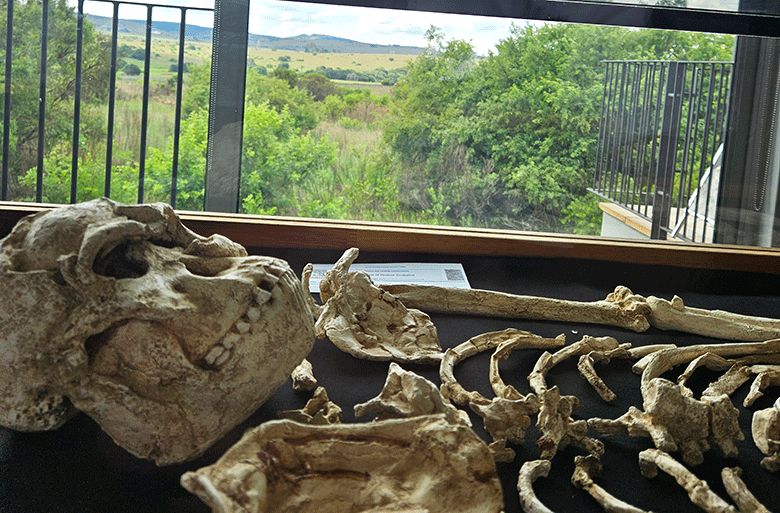
Museums are key sites where scientific and public knowledge intersect. The research project investigates how knowledge of early human evolution is produced in museums.
Recent developments in genomic and archaeological research have significantly complicated established narratives of human evolution. Evidence of interbreeding between Homo sapiens and archaic human groups such as Neanderthals and Denisovans, together with the discovery of new hominin species, has contributed to an increasingly complex scientific image of the human past. These findings reshape scientific debates and raise broader public questions about what it means to become human.
Against this backdrop, Unearthing the Human asks where and how processes of “becoming human” are produced in the public sphere. The project approaches museums as sites of knowledge production, where evolutionary narratives are actively constructed through exhibitions, displays, reconstructions, and educational formats. It examines which understandings of early human evolution are made visible, how they are communicated, and how they travel across different institutional and geographical contexts.
The project has since its inception collected a unique dataset, which to date involves visits to 41 museums across 24 countries on five continents (21 natural history, 10 site-specific, 8 historical, 2 science). All site visits were conducted from a museum visitor’s perspective, and the data consist of field notes, photos, maps, videos, and pamphlets.
Drawing on posthuman and sociomaterial approaches, Unearthing the Human critically examines boundaries between human and animal, nature and culture, and biology and history. Rather than positioning Homo sapiens as the endpoint of a linear evolutionary trajectory, the project understands humans as biocultural beings with complex, entangled origins. In doing so, it explores how public knowledge production participates in reshaping contemporary understandings of evolution, humanity, and our place within deep time.
Project manager: Simon Ceder, associate professor
Funded by the Magnus Bergwall Foundation, the Åke Wiberg Foundation, the Anders Karitz Foundation
Project period: 2019-ongoing