Could it be that it is precisely when occasions or things that cannot, or will not, lend themselves to being photographed arise, that the ideological foundation of photography reveals itself? Photography makes itself known only at its own boundary line, and then as an absence.
 During a mountain hike in Jämtland, I hear about an exceptionally beautiful lake called Blanktjärn. It has become famous for its azure-blue water, and I decide to hike there. But before I reach the lake, I am met by barriers erected by Länsstyrelsen (The County Administrative Board). The area has now been closed to visitors because excessive tourist traffic has damaged the fragile natural environment. I later discovered that the increased interest in the lake could be traced to photographs shared on social media. The lake’s crystal-clear water had attracted so many visitors eager to photograph themselves at the site that the authorities saw no alternative but to close off the area.
If we want to understand the nature of our relationship to photography, we can make use of anecdotes like this one. The example clearly illustrates a conflict that often emerges through photography. We are dealing with a technology that, on the one hand, channels desire, creates access, and, if one wishes, democratizes; yet on the other hand, territorializes spaces, channels ownership, and exploits resources.
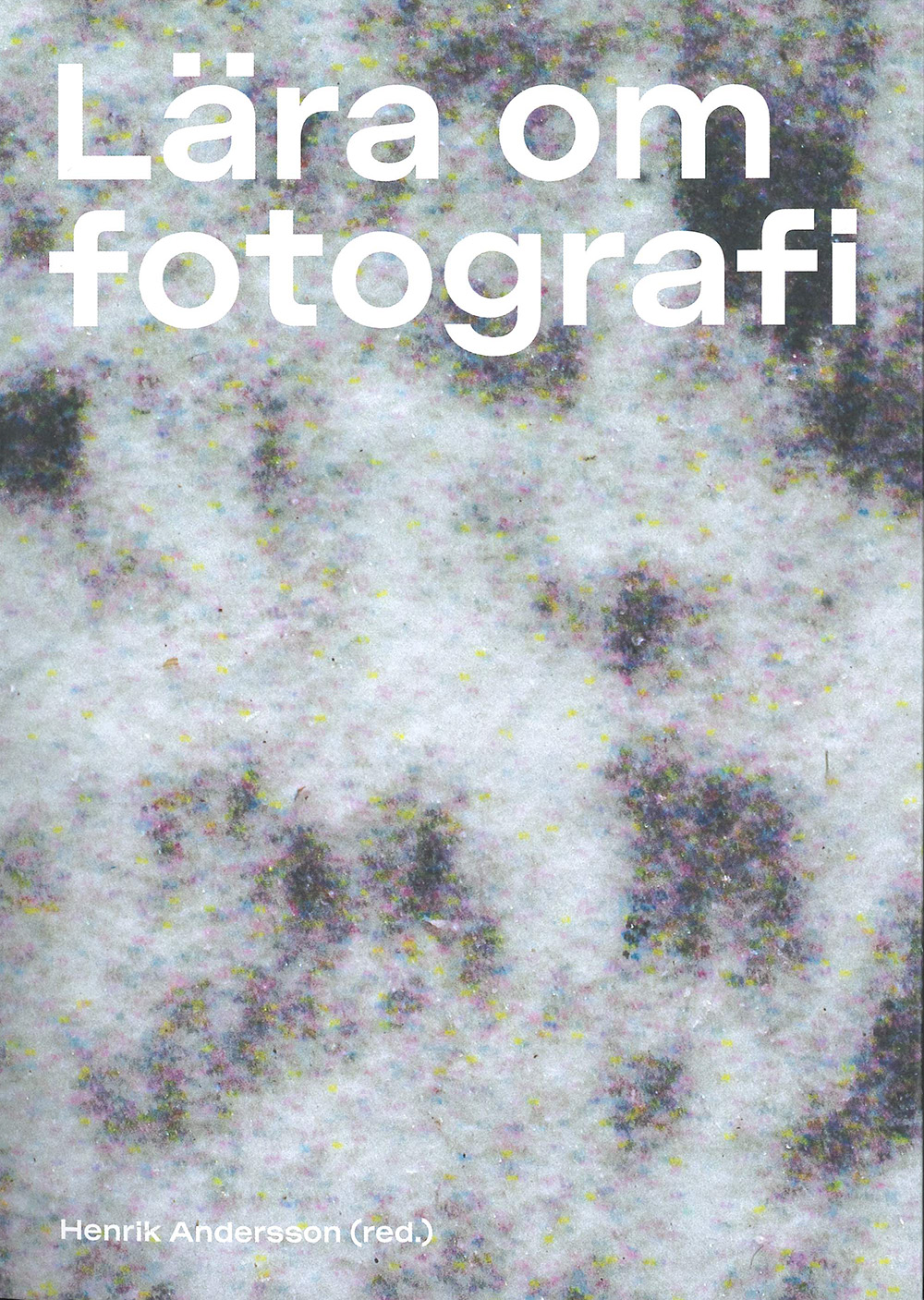
It is this material reality that Lära om fotografi (an ambiguous title that can be read as Learning or Teachings About Photography) seeks to understand. Over the past decade, we have seen growing interest in the history of photography in Sweden. This can be viewed as a consequence of digitization, which has made increasing numbers of historical photographs accessible. However, attention to photography as a whole has largely been guided by what might be called an idealist historiography, one that has focused more on individual figures and dates and less on the material conditions that make photography possible.
Lära om fotografi examines a dynamic within photography that manifests itself through conflicts and contradictions. It aims to provide answers about our relationship to photography rather than to establish its inherent qualities. Rather than attempting to define the boundaries of photography, or claiming ownership of photography as an idea, the collection of texts in this book seeks a new critique of photography. How can critical distance become a tool for understanding photography when the technology itself may be said to be founded upon an optical separation from the world?
The texts in this anthology all seek to say something about our relationship to the world of images. Each of them, in one way or another, takes as its point of departure the division and structuring of the world that, since the Enlightenment, has given us the dichotomies that shape our lives and with which photography is closely intertwined.
The work on this book builds upon a long tradition of photographic education at Konstfack. From Akademin för fotografi (The Academy of Photography) to today’s Department of Fine Arts, there runs an unbroken line of critical discussion about the photographic medium and curiosity toward photographic practice. In this context, I would especially like to mention Hans Hedberg, Irene Berggren, and Svante Larsson, whose work with photographic education at Konstfack cannot be overestimated.
These texts grew out of lectures given in the independent courses Fotografins historia (History of Photography) and Fotografiska seminariet (Photographic Seminar). Lära om fotografi therefore has a pedagogical dimension as a vehicle for knowledge, but the book also contains an ambition to renegotiate, or to “learn anew,” established positions within photography.
I would like to thank all participants in the photography courses: lecturers, students, and above all the authors of the book’s texts. All of them have been courageous and ventured into unknown terrain, returning not with answers but instead with new questions.
Editor: Henrik Andersson
Design: Sebastian Wadsted
Text editors: Jenny Lindblad och Johannes Björk
Language: Swedish
Series: Konstfack Education Collection 7
ISBN: 9789185549719 (March 2026)
Download the book here (PDF)
The printed book on price comparison site Bokfynd