Another four positions in Konstfack's doctoral education in Artistic Practice in Visual, Applied and Spatial Arts have been filled. Welcome Evelina Dovsten, Juliane Foronda, Jenna Gillinger, and Kristian Vistrup Madsen whose projects span over tacit knowledge, spatial design preventing violence, craft-care-control and mood over content in curatorial practice.
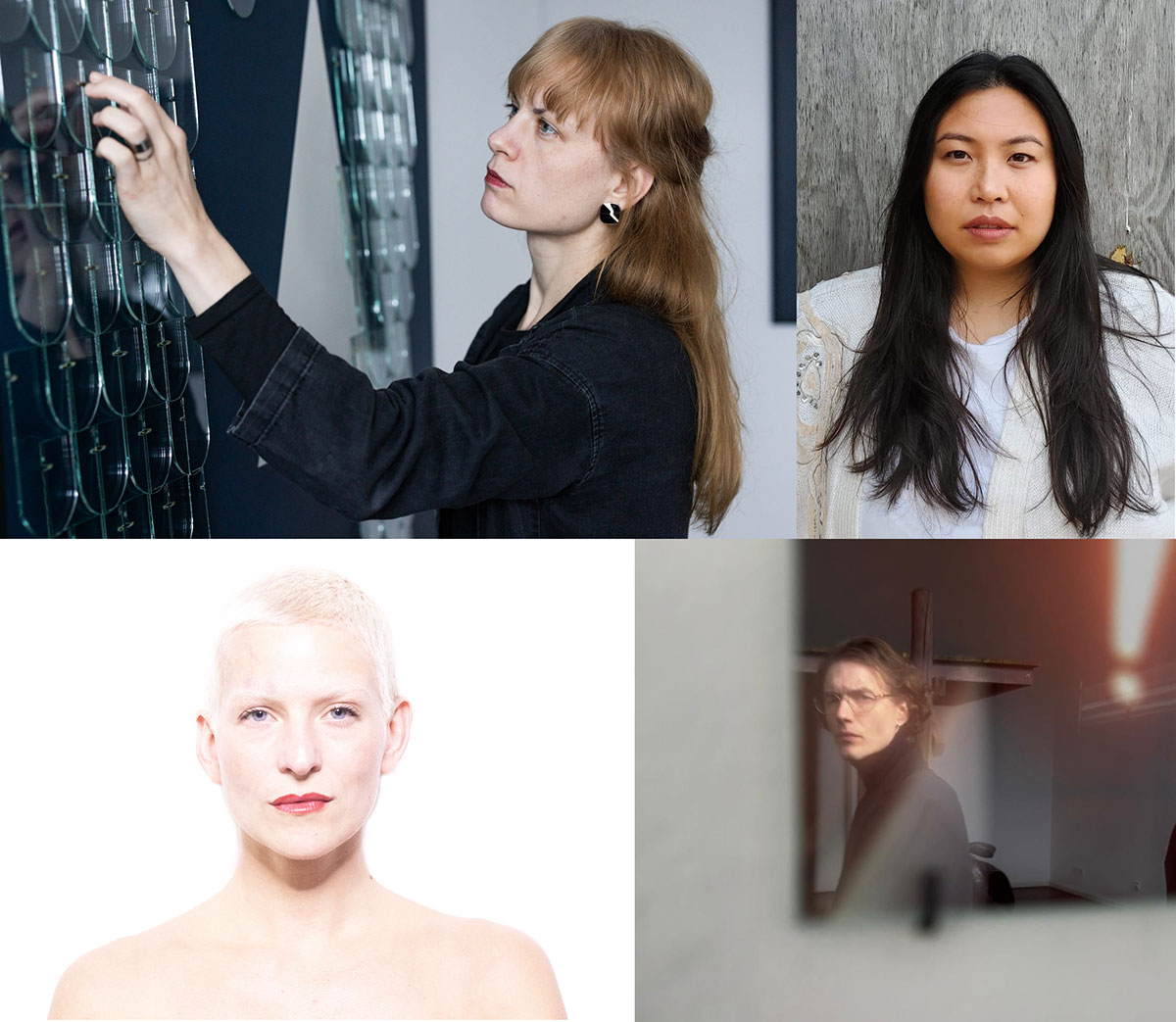
From left:
Evelina Dovsten, Juliane Foronda
Jenna Gillinger, Kristian Vistrup Madsen
In her PhD project Swedish artist and glassblower Evelina Dovsten aims to examine how craft knowledge can give us a new historical perspective, by using her artistic practice in combination with tacit knowledge theory and ethnographical methods. “Craft holds keys to our historical heritage that are important for making informed decisions and to take action regarding preserving and keeping on a craft tradition in contemporary society. If the knowledge stored in objects no longer can be read out by a contemporary maker it becomes anonymous. And thereby lost forever.” She claims that we need to keep on having access to our history both within the language of theory and practice and plans to map out her results and findings in glass, texts and more, based on the questions: How can craft knowledge give us new perspectives on history objects? How do we preserve glassblowing knowledge, and how is it passed on to others? What knowledge do we store in our objects today, and what are we communicating to our future colleagues?
Department of Crafts: Glass – Dovsten, Evelina
Juliane Foronda is a Filipina-Canadian artist, writer, and researcher who brings her project “The Intimate Geography of Pockets: textiles, resistance, and radical care” to Konstfack, investigating what it means to keep something close. This practice-based PhD explores the pocket as a subtly radical form, both intimate and (infra)structural, where craft, care, and control converge. Positioned within textile heritage and feminist theory, the project reimagines the pocket not simply as a functional detail, but as a site of poetic and political tension: a place to hold, to hide, to host. As clothing and gender norms evolve, and as storage increasingly moves into digital space, this research also considers the speculative futures of the pocket. The project will unfold through archival research, participatory workshops, textile production, and text-based artistic practice. By investigating what is kept, by whom, and why, this project seeks to challenge dominant modes of collection, preservation, and inheritance.
Department of Craft: Crafts Textile/Textile Heritage – Foronda, Juliane
Swedish artist, furniture designer and interior architect Jenna Gillinger examines in her project “No Room for Violence”, how spatial design can be used as a tool to prevent violence and counteract re-traumatization of women exposed to domestic violence. Women aged 16–25 and victims of domestic violence represent 67% of the total of people exposed to violence in Sweden, yet the environments in which these women seek help – from the home to emergency clinics, police stations, and courtrooms – often are spaces that retraumatize rather than support.
Through case studies, spatial analysis, workshops, participatory research etc. the project investigates how spatial and material conditions interact with psychological processes in situations of vulnerability and critically. “How can interiors act as co-agents in shaping survivors’ experiences, and how might architectural interventions serve as tools for violence prevention, emotional recovery, and social justice?”.
Department of Design, Interior Architecture and Visual Communications: Interior Transformations – Gillinger, Jenna
Kristian Vistrup Madsen – writer, art critic, and curator – proposes a practice-based PhD in which to develop the concept of Stimmung as central to curatorial practice. The term is related to voice, attunement and atmosphere, the pitch that always-already exists in a room, even before the introduction of object and subject. “How do we overcome a century of modernist alienation and postmodern irony? My hypothesis is that Stimmung could be the key to a less alienated, more spirited kind of contemporary art.” The project is structured by three main avenues of curatorial research: ritual, self and site, approached through a methodology that privileges practice over theory, diffractive readings over interpretation, and surrender over agency.
Department of Fine Art: Artistic and Literary Writing and Curatorial Practice – Vistrup Madsen, Kristian