Here's a recap from Konstfack Research Week 2026, four knowledge-sharing days of exploring Sensory Knowledge: Tactile practices & Embodied Learning.
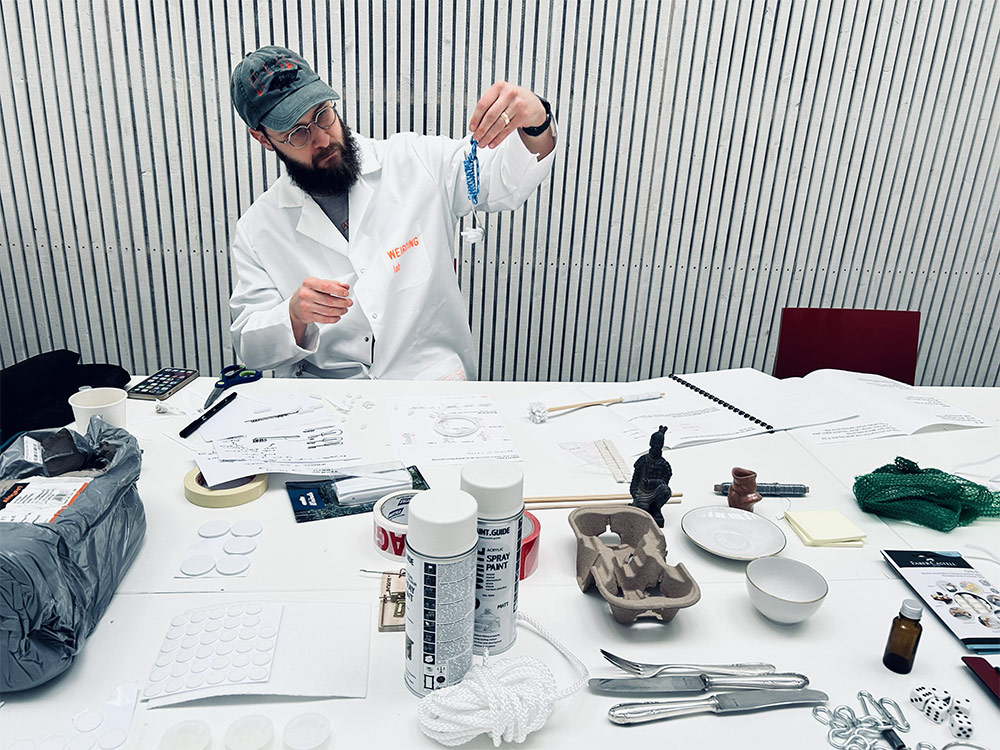
Daniel Daam-Rossi, Weirding Foundations: A Lab for Mental Palette Cleansers
Thanks for joining us at our platform for reflection, interdisciplinary exchange and public accessibility exploring Sensory Knowledge: Tactile practices & Embodied Learning within artistic research. Here a short summary with a few examples. For the entire programme, see link in the end.
During four days researchers, artists, educators, doctoral candidates, and invited guests was brought together to a vast programme highlighting how knowledge is produced through material engagement, bodily experience, and situated practice across art, craft, design, architecture, visual communication, and teacher education. Project leader was Professor Maja Gunn, Department of Crafts.
Through keynote lectures, scholarly presentations, workshops, performances, and research nodes, the week foregrounded artistic research as a socially engaged mode of inquiry. All with the aim to show how our research can influence and interact with society at large, to engage with diverse contexts and to contribute with new insights.
Particular attention was given to practices of making, sensing, moving, and inhabiting environments, as well as to questions of pedagogy, sustainability, heritage, public space, and political expression.
The week was inaugurated on 26 January by introductions to the core theme by Konstfack’s Vice-Chancellor Anna Valtonen, Head of Research Magnus Bärtås and Professor Maja Gunn. The keynote speakers then gave their perspectives on the topic.
Kristina Hagström-Ståhl – The Slowness of Hands and Thought – explored how tactile, embodied practices such as handwriting and working with archives shape critical and creative thinking. Drawing on archival research, translation, and performance-making, she argues that slowness and material engagement are central to interpretation, mise en scène, and ethical forms of witnessing, bridging theory and practice.
Gry Worre Hallberg – Sisters Hope: Embodying a Sensuous Society, presented the vision of a “Sensuous Society,” developed through Sisters Hope’s immersive performance practices at the intersection of art, activism, education, and research. The work examines how sensuous and poetic ways of inhabiting the world can foster ecological connectedness, framing aesthetic inhabitation as both artistic method and societal model.
Daniel Peltz – Shying a Way – introduced a two-year artistic research project on shyness as a form of extra-sensory awareness and knowledge, explored across Nordic and Pan-African contexts. Framed as an alternative pedagogy and aesthetic strategy, the project culminates in a publication and the proposed “School of Shying a Way,” challenging dominant modes of participation and visibility.
Konstfack Research Week offered, as usual, presentations and discussions by Konstfack researchers and faculty, exploring theme-related research and pedagogical perspectives. A full day during which researchers from all of Konstfack’s departments presented various projects; the ones mentioned below are just a few examples. Like Water Bodies – Corpus, Flow and Leakage by Sissi Westerberg, Senior Lecturer, Smycke & Corpus, a project exploring how craft can be combined with practical science from the field of hydrology and investigating how the vessel form (corpus) can be used to visualize flows, leakage and filtration in relation to contaminated water.
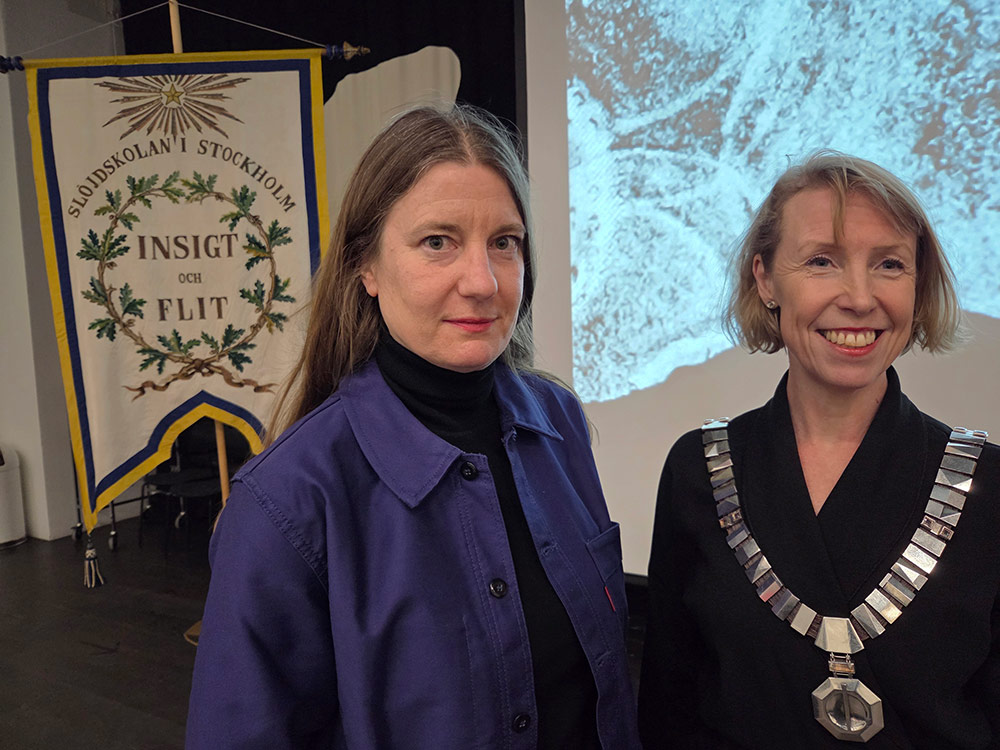
Professor Cecilia Grönberg and Vice-Chancellor Anna Valtonen.
Professor Cecilia Grönberg delivered her inaugural lecture, Investigative Practices & Material-specific Knowledges, presenting an overview of her 25-year artistic and research practice. She described a body of work shaped by long-term, archive-based investigations spanning photography, publishing, exhibition formats, and transdisciplinary artistic research. Grönberg also spoke about her close collaboration with Jonas (J) Magnusson, with whom she runs OEI, a literary and artistic publishing project. Together, they engage with questions of materiality, montage, alternative histories, and the politics of inclusion and exclusion.
PhD student Johanna Enger’s performance lecture and 90% seminar took place: In Search of the Measurable, the Immeasurable, and the Elusive Experience of Light. The research explores the intersection of technical, qualitative, and experiential aspects of light.
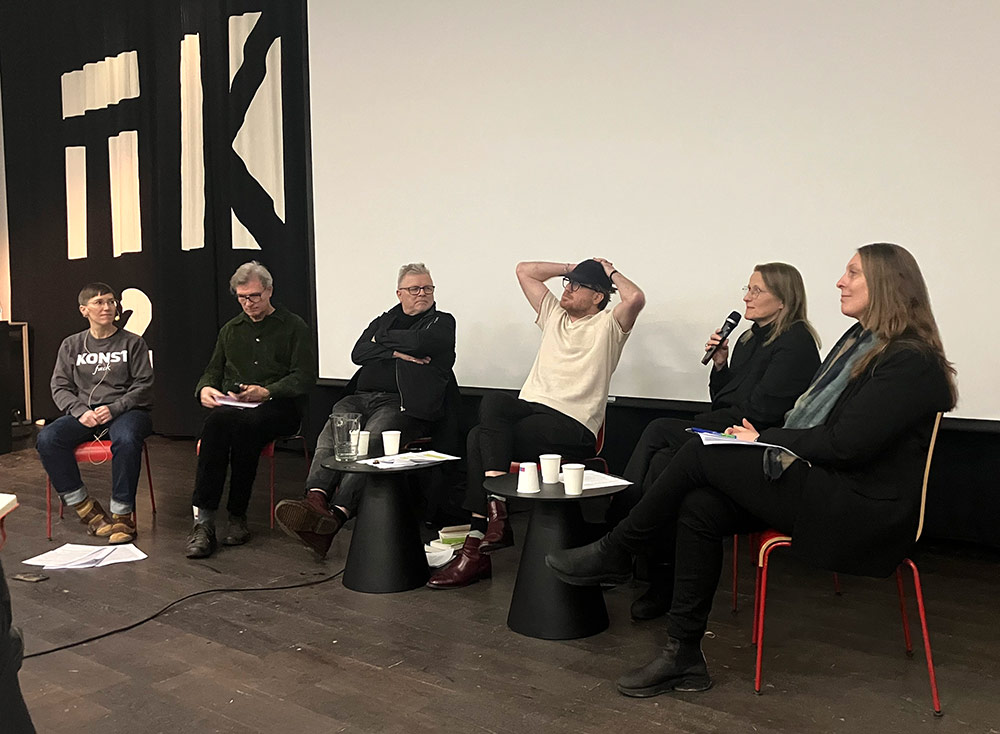
Bitte Andersson moderating the panel discussion Election Year! What's at Stake For Arts Universities? with Magnus Bärtås, Per Nilsson, Magnus Sterner-Bernvik, Sanne Kofod Olsen and Maj Hasager.
The first of seven Nodes, Materialising Opinion, was connected to the research project Visual Empowerment. It activated Konstfack’s long tradition of politically engaged art and design and explored freedom of speech through collectivity. A panel discussion, chaired by PhD student Bitte Andersson together with leaders of the artistic academy, took as its point of departure the response “We Object” by the Vice-Chancellor of the Royal Institute of Art, Sanne Kofod Olsen ("Vi opponerar oss", published in her column on 14 January), addressing formulations in Tidö 2.0, authored by Timbro and Oikos. The debate focused on how the artistic academy should navigate today’s political landscape: the necessity for institutions to speak out; issues of academic and artistic freedom; the arm’s-length principle; political warnings and modes of governance through defunding; the Kalven Report and its exemptions; courage, hatred, and threats; and the importance of creating spaces for dialogue and encounters around questions such as this panel discussion at Konstfack Research Week.
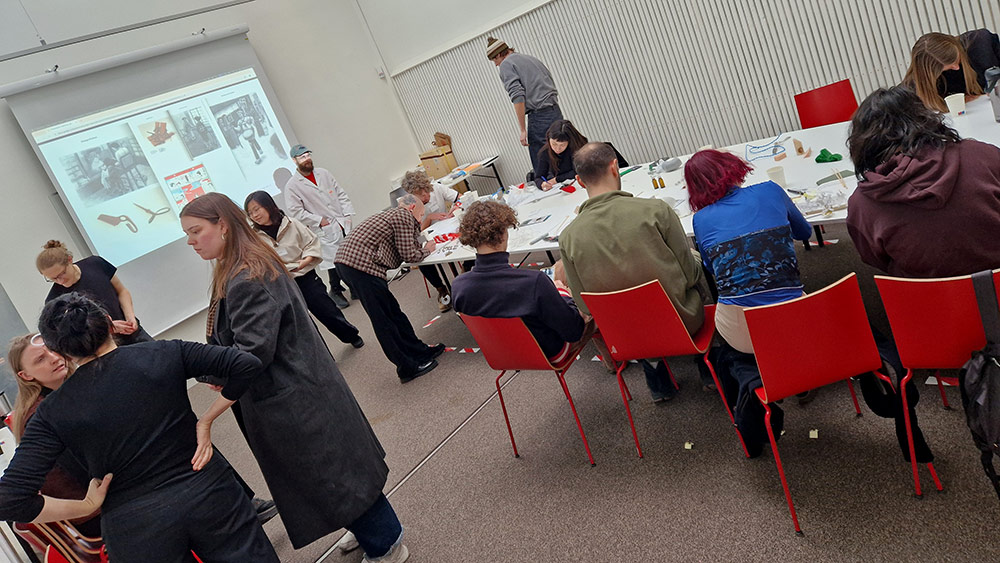
Weirding Foundations: A Lab for Mental Palette Cleansers
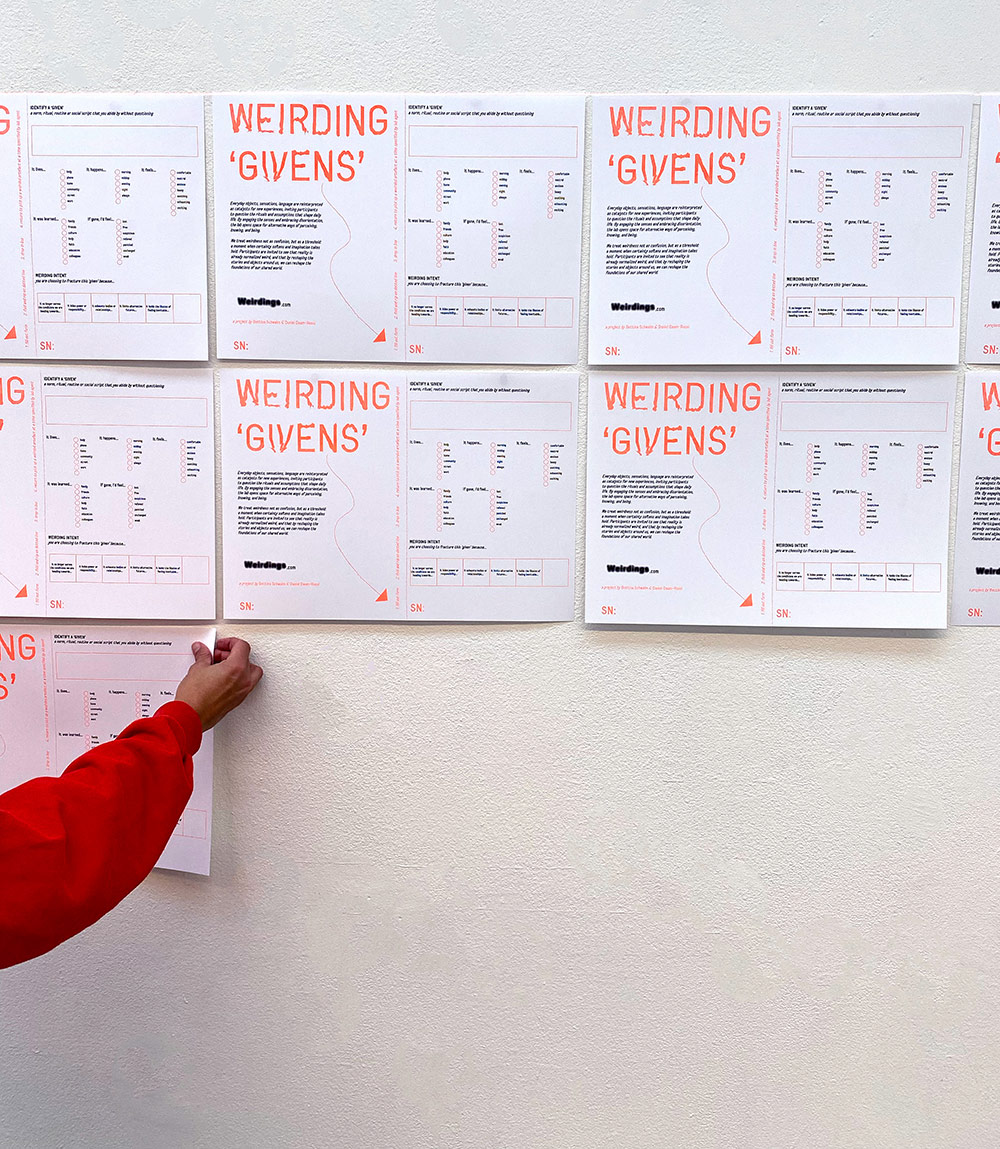
Later on we got acquainted with Weirding Foundations Lab, a participatory lab exploring how we can unlearn, reimagine, and re-fabricate the familiar. Through a series of experiments called "Mental Palette Cleansers", participants become fellow "weirders"; researchers who are tasked with disrupting ‘givens’ - the unquestioned scripts of daily life. The researcher in charge, PhD student Bettina Schwalm explained:
- Everyday artefacts, sensations and language are reinterpreted as catalysts for new experiences, inviting us to question the rituals and assumptions that shape our ways of perceiving, knowing, and being. We treat weirdness not as confusion, but as a threshold: a moment when certainty softens, and imagination takes hold. Participants are invited to see that reality is already ‘normalised weird’, and that by reshaping the stories and objects around us, we can reshape the foundations of our shared world.
Overall, four very well-attended days in which new knowledge, new connections, and ideas took shape. Thank you to everyone who took part!
Here is the whole programme: Konstfack Research Week 2026 Booklet.pdf