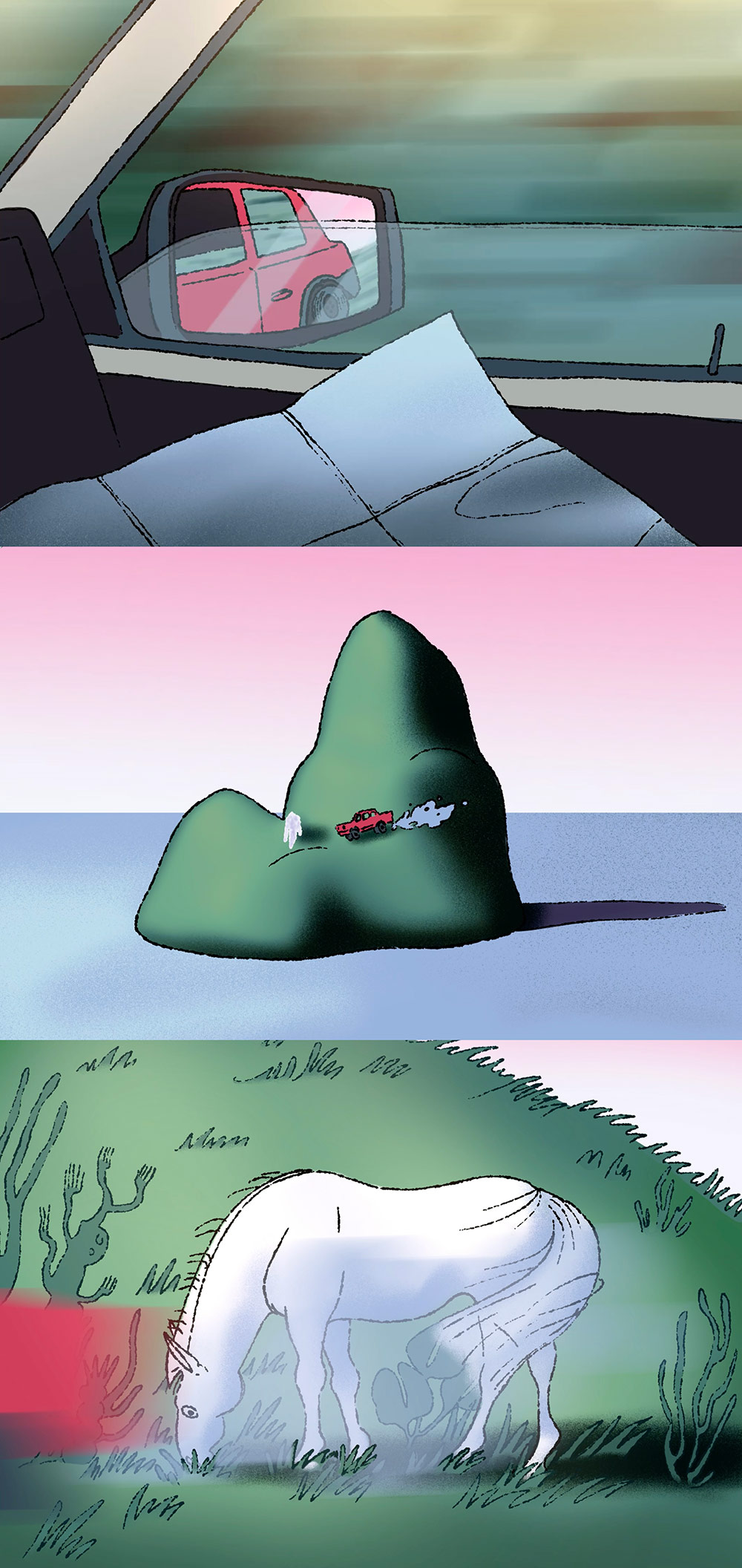
Stills from Frida Imgård's animations.
Animated Collaboration with Students in the West Bank, Letterforms and School Newspaper
Animations from the course “Analog and Digital Storytelling” are presented, in which students from the Bachelor’s programme in Graphic Design and Illustration shared teaching with students at Birzeit University in the West Bank, Palestine. They took part in joint lectures, tutorials, and animation assignments. The course included the assignment “3”, where each student created three animated loops to be displayed on three separate screens—an opportunity to explore the possibilities that emerge when synchronized visual streams interact.
The outcomes of the course “The Letterform – An Introduction to Typeface Design” are also presented by second-year students in Graphic Design & Illustration. The exhibition shows how a typeface takes shape, from sketch to digital translation using the software Glyphs. Students construct alphabets based on geometric forms and practice various sketching methods, both analog and digital, a process that culminated in the exhibition project.
Another project by second-year students in Graphic Design & Illustration is titled “School Newspaper REMIX.” The students approached Konstfack as a living archive of experiences, memories, and traces. Working from themes such as parties, previous student publications, gossip, the basement, and degree projects, the students collaboratively created Dorgan, a school newspaper rooted in both the present and the past.
Will there be food in 2060?
How will future climate change affect our food supply and access to food? In this exhibition, first-year students on the master’s programme Design Ecologies present some possible answers to this question through prototypes of future, climate-adapted agricultural value chains, designed to secure food production in a world where the average temperature is three degrees or more above today’s levels.
Drawing on signals and trends that point to possible future social, technological, environmental and cultural developments and changes, the students have developed a range of scenarios in consultation with, among others, researchers at SLU, the Stockholm Resilience Centre and Axfoundation. Based on these scenarios, the students have then imagined what future value chains might look like, developed and concretised them, and not least explored how they could take shape as product and service systems in Sweden in the year 2060.
The work is part of the Vinnova-funded project “Future-proofed food supply for health and wellbeing”.
The names of all participating students and teachers are listed in the respective exhibitions, 4–7 February.